The Group always seeks to operate with respect and responsibility towards the environment, setting targets and taking decisions and measures to protect it and reduce its environmental footprint.
Protection of the Environment
The Group always seeks to operate with respect and responsibility towards the environment, setting targets and taking decisions and measures to protect it and reduce its environmental footprint.

Protection of the Environment
Τhe Group’s environmental care, as well as the effective management and response to environmental risks, are an integral part of its strategy and one of the central pillars of its business model.
In particular, the Group’s environmental strategy aims to:
Responsible environmental and energy management

The Group implements an integrated Environmental and Energy Management System aimed at the timely identification and analysis of environmental and energy risks. This approach enables continuous improvement in environmental performance and the effective implementation of the Group’s strategy to reduce environmental impacts. The steps of the strategy are as follows:

The Environmental Management System of the Group and its subsidiaries, namely TERNA, TERNA LEFKOLITHI, NEA ODOS, KENTRIKI ODOS, HERON Group, and GEK SERVICES, is certified in alignment with the international standard ISO 14001:2015. In addition, TERNA applies an Energy Management System, certified according to ISO 50001:2018, across all its projects and facilities.

Responsible energy management and conservation
The Group implements targeted measures to ensure the efficient management of energy consumption and the responsible use of natural resources across all its operations. Within this context, it systematically records and monitors energy consumption across offices, construction sites, and facilities, with the aim of assessing its energy needs and implementing actions to reduce consumption.
In 2025, the Group’s total energy consumption amounted to 5,605,664.2 MWh (20,180.4 TJ). Energy use comprises electricity consumption as well as fuels for stationary and mobile combustion. Total electricity consumption reached 111,098.5 MWh, of which 66.2% originated from renewable sources, either through the procurement of Guarantees of Origin or through self-consumption of electricity generated from renewable energy sources (RES).
At the same time, the Group implements the following measures on an annual basis to ensure the effective application of its ESG Policy and its commitments to reducing its energy footprint and contributing to global decarbonization efforts.
Promotion of long-term Power Purchase Agreements (PPAs) in Greece.
- HERON offers long-term Power Purchase Agreements (PPAs) to large commercial and industrial consumers, secured through corresponding agreements with photovoltaic park producers.
- By the end of 2025, HERON maintained an active portfolio of 22 corporate PPAs, with total contracted energy of 93.3 GWh annually, serving industrial companies and large commercial customers across various sectors of the Greek economy. Through PPAs, customers secure long-term access to electricity from Renewable Energy Sources (RES) at a stable, competitive price, typically over a horizon of ten to twenty years, while simultaneously gaining predictability in their energy costs and documented reduction of their carbon footprint, as each MWh is accompanied by a corresponding Guarantee of Origin (GO) from Greek RES plants.
- HERON’s strategy is fully aligned with national and EU targets, supporting the competitiveness of Greek enterprises, increasing the penetration of renewable energy sources (RES) in the energy mix, and accelerating the development of new RES projects through bilateral commercial agreements with end consumers.
Issuance of guarantees of origin (GOs): Provision of Guarantees of Origin to business clients upon request, as well as to residential customers who choose the ECO GENEROUS commercial programs. These Guarantees of Origin—or Green Certificates—are issued by the RES and Guarantees of Origin Operator (DAPEEP) in accordance with EU Directives 2003/54/EC and 2009/72/EC and national legislation, certifying that a specific quantity of electricity was generated from RES.
Replacement of the passenger vehicle fleet with electric and hybrid vehicles.
Upgrade of lighting and air conditioning equipment using energy-efficient technologies.
Integration of energy-saving principles into construction projects—where feasible—through building insulation, use of energy-efficient windows, and optimization of natural lighting and ventilation.
Support for obtaining green building certifications for construction projects, such as LEED, BREEAM.

Contributing to mitigation and adaptation to climate change
The Group acknowledges that climate change is one of the most significant challenges of our time and actively participates in national and international efforts to mitigate climate change while effectively adapting to its inevitable impacts. With a consistent focus on respect for the environment and society, the Group shapes its business model and strategy in a way that integrates the principles of responsibility and sustainability, confirming its commitment to effectively addressing the climate crisis.
In the context of its ESG Policy implementation, the Group has set specific commitments regarding the management of energy and greenhouse gas emissions:
- Annual monitoring and reporting of GHG emissions across all Group subsidiaries.
- Implementation of targeted action plans to reduce its carbon footprint.
- Guarantees of Origin covering 100% of the Group’s subsidiaries by 2030.
- Achievement of a minimum participation rate of 70% in energy-related training across its workforce.
Through these targeted initiatives and commitments, the Group aims to reduce its energy footprint while systematically integrating climate-related risks into its operational processes, thereby strengthening its competitive positioning and enhancing the long-term value delivered to its stakeholders.

Protecting and preserving biodiversity
Given that a large part of the activities is carried out in biodiversity-sensitive areas, an environmental management system is applied covering all Group activities. To this end, the following take place on an annual basis:
- Implementation of certified systems.
- Staff training on biodiversity protection at project sites.
- Initiatives promoting the protection and enhancement of local ecosystems (e.g. tree planting).
- Application of Best Available Techniques (BAT) in the industrial facilities’ production activities.
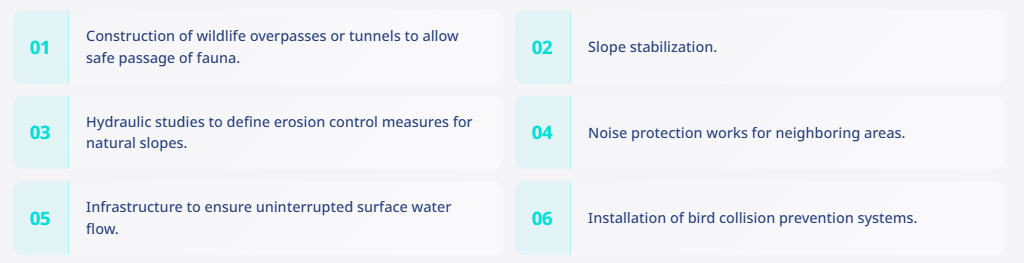
Through these actions, the Group seeks to strengthen its positive contributions while reducing actual and potential negative impacts arising from its operations, with the aim of preventing incidents of biodiversity degradation. At the same time, in full compliance with the approved environmental terms of its projects and to ensure responsible business operations, the Group undertakes necessary measures such as:

Rational resource management and enhancing circular economy
Circular economy is a strategic pillar of the Group’s ESG approach, reinforcing the sustainability of its business model and making a substantial contribution to environmental protection. Its principles are applied horizontally across key operational areas, with the aim of:
• Preserving and optimally utilizing natural resources and raw materials
• Effectively managing waste
• Enhancing efficiency throughout the entire lifecycle of products and services
This approach is embedded within the Group’s broader sustainable development framework and supports the transition toward a more resilient and environmentally responsible business ecosystem.
Preservation of Natural Resources and Raw Materials
Responsible selection of raw materials is a key priority for the Group, as it directly impacts both the quality of its projects and its environmental and energy footprint. In this context, emphasis is placed on the use of high-specification materials that are durable under extreme weather conditions and have a low environmental impact, thereby supporting sustainability and the circular economy.
At the same time, for specific categories of waste, the Group promotes the reuse or recycling of materials (e.g. excavation, construction, and demolition materials) to meet the needs of other business activities. This practice contributes to waste reduction, conservation of natural resources, and the interconnection of operational units through circular material flows.
Waste management
The Group implements a holistic waste management program for both hazardous and non-hazardous waste, with the primary objective of reducing both the volume and the hazardous nature of the waste generated. At the same time, it aims to continuously improve environmental performance indicators, with a strong focus on avoiding landfill disposal and promoting material recovery.
Waste management practices are structured around a prioritized hierarchy of actions aligned with circular economy principles, placing emphasis on waste prevention, preparation for reuse, and recycling. Final disposal is considered only when no other viable alternative exists and is always carried out in accordance with applicable legislation. Through this approach, the Group enhances resource efficiency, minimizes environmental impacts, and promotes the sustainable operation of its activities.
Waste management is conducted in compliance with the Approved Environmental Terms, internal procedures, and project-specific requirements, in collaboration with licensed entities for the collection, recovery, treatment, and final disposal of waste.
Rational management of water resources
The responsible and efficient management of water constitutes a core pillar of the Group’s environmental strategy, reflecting a strong sense of responsibility towards both the natural environment and the human rights of local communities. Water is recognized as a valuable natural resource of limited availability, the management of which directly affects quality of life, ecosystems, and the long-term resilience of the areas in which the Group operates.
In this context, the Group undertakes initiatives aimed at improving water efficiency, implementing practices and continuous improvement programmes across the full range of its activities. This approach takes into account the specific characteristics of each project and facility, as well as local conditions related to water availability and stress, ensuring that actions undertaken are both meaningful and effective. Where technically feasible, water recycling and reuse practices are applied in selected operational processes, reducing the demand for freshwater and maximising the use of available resources.
At the same time, ensuring the quality of both water used and wastewater generated is a key priority. To this end, the Group conducts systematic quality controls in collaboration with authorised and accredited laboratories, with the aim of verifying compliance with applicable quality standards and environmental regulatory requirements. The results of these controls are used to continuously monitor performance and to enable the timely implementation of corrective actions where necessary.
As part of the preventive management of impacts on natural water systems, pollution control measures for stormwater runoff are implemented across all Group projects. These measures include, among others, appropriate drainage infrastructure, sediment control systems and preventive practices at construction sites, in order to prevent the transfer of pollutants to surface and groundwater.
Specifically, the Group’s efforts focus on:
- Regular employee training on proper and responsible water management practices
- Analysis of the risks and impacts associated with improper water management
- Implementation of water recycling and reuse practices, where technically feasible
- Regular water and wastewater quality monitoring through authorized laboratories
- Implementation of stormwater pollution prevention measures across projects and construction sites
- Implementation of an Environmental Management System
- Programs to reduce water consumption
- Responsible water discharge
