
Creation of Direct and Indirect Economic Value
For GEK TERNA Group, a core priority is to ensure that its growth generates a multiplying effect for the national economy, employment, and Greek society. In an environment that is constantly evolving and marked by heightened uncertainty, the need for targeted initiatives and strategic choices that support the Group's stable operation has become more pressing than ever. Through investments in innovation, enhanced efficiency, and the adoption of new technologies, the Group seeks to continuously create added value, while further strengthening its reputation and credibility.
Economic prosperity, business continuity and support for local communities are integral parts of the Group's long-term strategy and key drivers of value creation. Therefore, they are embedded in the business model, aiming not only to meet shareholders' expectations, but also to create a positive impact for all stakeholders including customers, employees, shareholders and the wider society.
In 2025, the Group continued the implementation of its investment program, with the total value of investments in the medium-term pipeline amounting to €1,346,159 thousand. The Group's consistent investment activity lays the foundation for a steadily increasing and sustainable stream of revenue and profitability over time. It is worth noting that, in 2025, there were no project cancellations associated with social or environmental impacts.
Turnover per business segment (in millions €)
The Group makes a substantial contribution to public revenues in the countries in which it operates through the payment of taxes, while also indirectly supporting the economy through the taxes paid by its suppliers and business partners. At the same time, the implementation of modern environmental projects contributes to the creation of new jobs and enhances value added in critical sectors of the Greek and European economy, such as construction, metallurgy, and concrete.
Case study — Seirios: Hybrid ultra-fast charging station integrating solar energy and storage
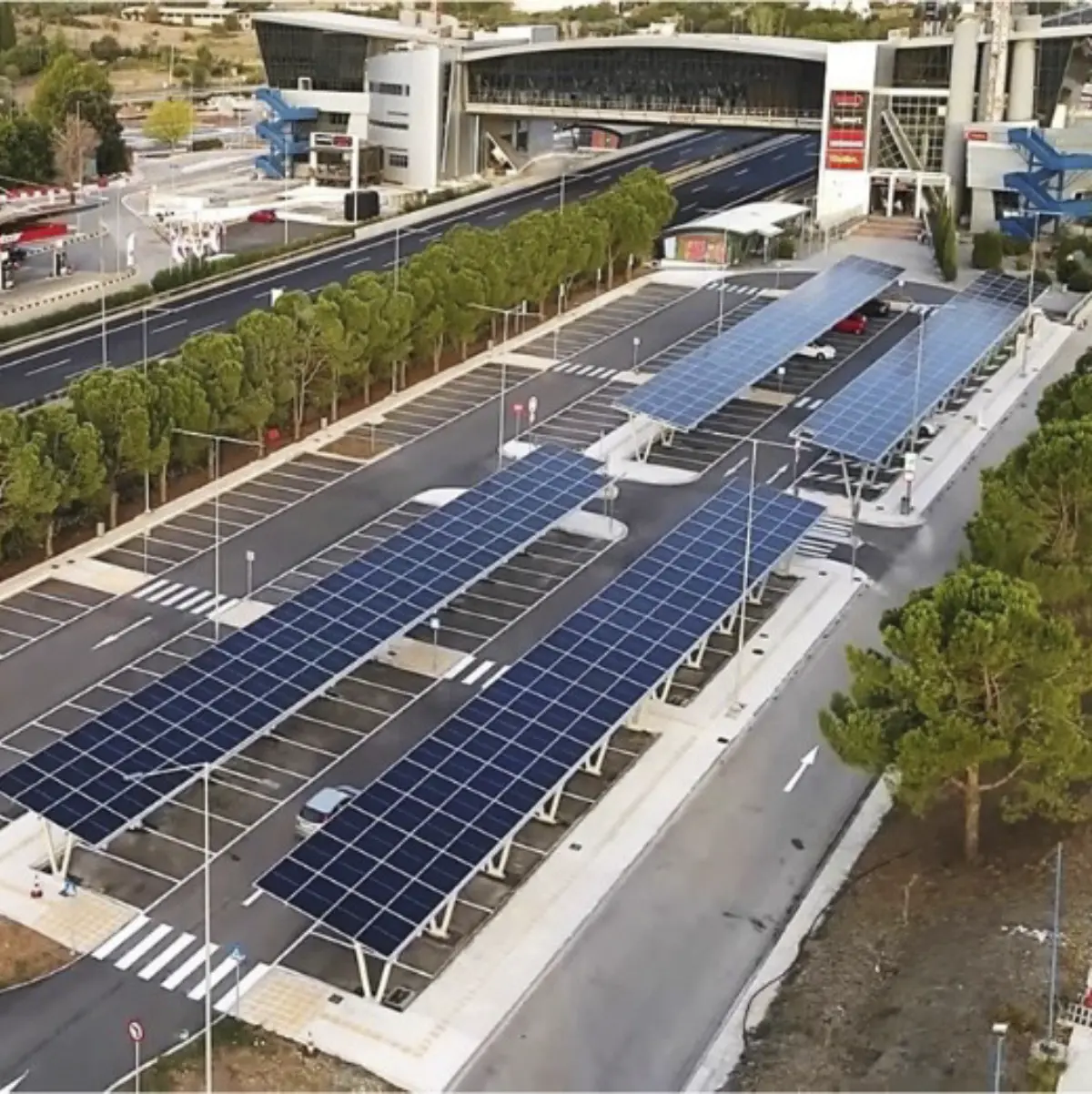
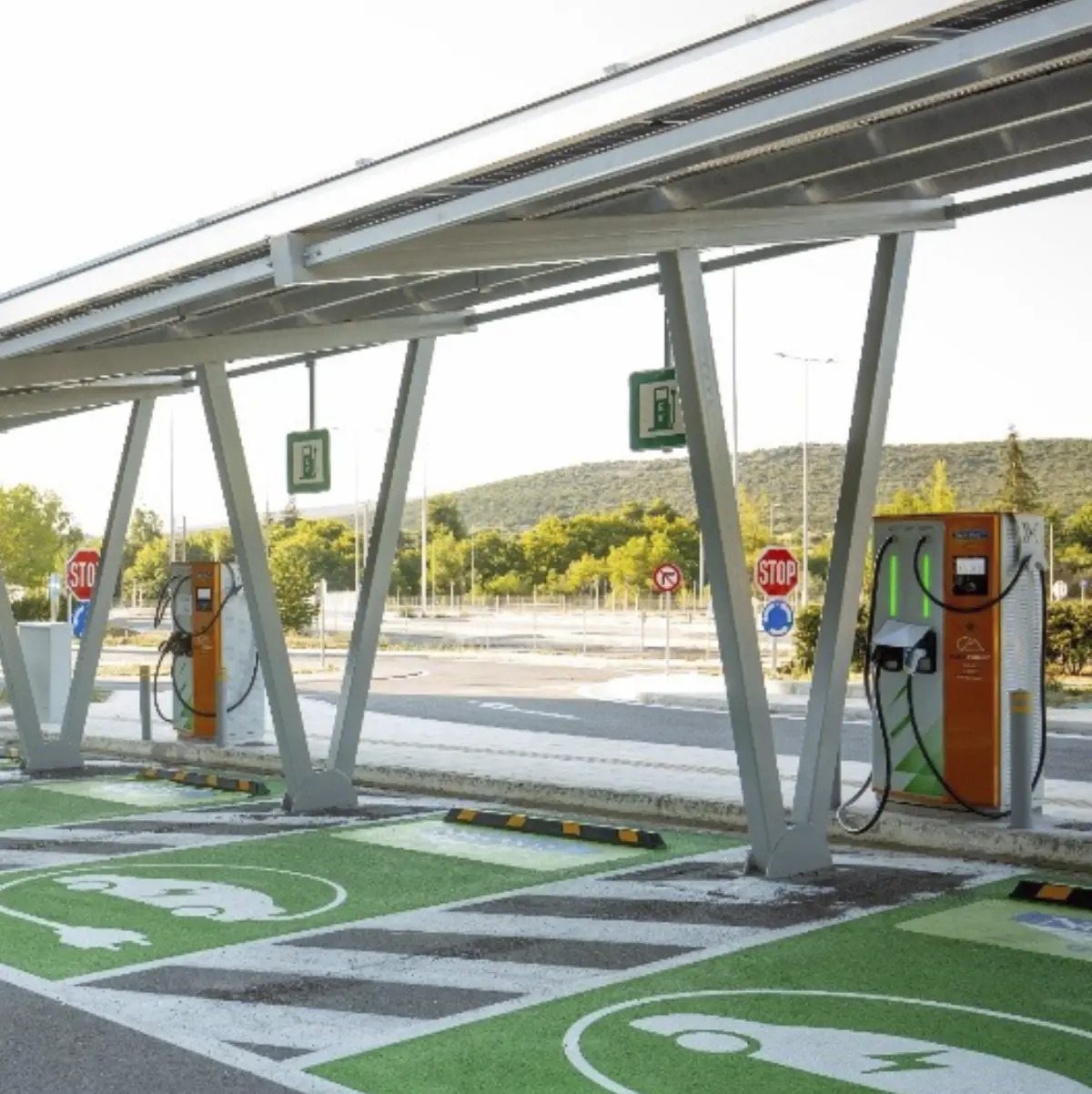
The hybrid ultra-fast electric vehicle charging station at Seirios Malakasa, the largest Motorist Service Station in Greece, attracted even more electric vehicle users in 2025. Last year, approximately 16,650 charging sessions were carried out, representing a 39% increase compared with 2024. The innovative hybrid ultra-fast charging station was implemented as part of GEK TERNA Group's strategy to promote sustainable mobility, energy innovation and the efficient utilization of renewable energy sources.
The project combines the use of solar energy, energy storage and high-power charging technology in a single integrated architecture.
The installation includes a 486 kW photovoltaic system, a 339 kWh battery energy storage system (BESS) using lithium-ion technology, and 120 kW ultra-fast chargers. The locally generated energy can support the charging of up to 30,000 electric vehicles annually, while surplus energy that is not consumed by the chargers is used to cover the energy needs of the station's food service and retail facilities.
A central element of the project's innovation is the DC-link architecture, which enables more direct and efficient energy management between the photovoltaic system, the storage system and the chargers. In this way, energy losses during system operation are reduced, the utilization of solar energy is enhanced and the overall performance of the charging infrastructure is improved.
This solution contributes to energy savings of approximately 12%–20% compared with other charging stations, while, thanks to the connection between the photovoltaics, battery and chargers, the system becomes significantly more efficient (10%–20%) compared with other ultra-fast charging stations. At the same time, it supports higher power delivery to the chargers, even when the available power at the grid connection point is lower.
The project also incorporates significant energy resilience features, as the station can continue to provide charging services even in the event of a power outage, thanks to the storage system and advanced operational control. In particular, the transition to off-grid operation takes place in less than 10 milliseconds, without affecting vehicle charging sessions. In the event of prolonged off-grid operation and provided that the battery state of charge reaches its lower limit, automatic activation of a backup generator is foreseen to ensure continuity of operation.
This project is a tangible reflection of the strategic direction of the energy transition: not only the development of individual technologies, but their integration into comprehensive, resilient and efficient infrastructure with a meaningful environmental, operational and social footprint. Through the combination of renewable energy, storage and advanced charging architecture, it showcases a realistic model that accelerates electromobility, strengthens energy resilience and creates measurable value for the economy and society.
The table below presents the direct economic value generated (revenues) and distributed (operating costs, employee compensation, payments to financial providers, contributions to the state by country, and investments with a social impact) for 2025 and 2024.
| 2025 | 2024 | Unit | |
|---|---|---|---|
| Direct economic value generated: Revenue | 4,011,920 | 3,379,701 | € thousand |
| Operational Costs | 3,070,803 | 2,738,372 | € thousand |
| Employee wages and benefits | 281,418 | 208,960 | € thousand |
| Payments to providers of capital | 430,825 | 201,805 | € thousand |
| Disbursements to public sector entities | 93,972 | 63,648 | € thousand |
| Greece | 93,292 | 63,129 | € thousand |
| Cyprus | 55 | -187 | € thousand |
| North Macedonia | 28 | 211 | € thousand |
| Albania | 5 | 2 | € thousand |
| Bulgaria | 365 | 117 | € thousand |
| Romania | 2 | 2 | € thousand |
| Serbia | 201 | 252 | € thousand |
| UAE | 1 | 7 | € thousand |
| Qatar | 5 | 6 | € thousand |
| Iraq | 0 | 4 | € thousand |
| Saudi Arabia | 1 | 62 | € thousand |
| Bahrain | 6 | 5 | € thousand |
| Poland | 0 | 0 | € thousand |
| USA | 7 | 38 | € thousand |
| Libya | 4 | — | € thousand |
| Malta | 0 | — | € thousand |
| Netherlands | 0 | — | € thousand |
| Donations and investments at the community level | 5,218 | 3,699 | € thousand |
| Direct economic value distributed | 3,882,236 | 3,216,484 | € thousand |
| Direct economic value retained | 129,684 | 163,217 | € thousand |